An article can explain. A prototype can let people try. For many AI topics, the best content is not a longer text, but a small tool that helps the visitor position themselves: calculate, choose, diagnose, rephrase, compare.
That is the value of an agentic web prototype. Not a huge autonomous agent. A precise module, attached to a page, that turns a question into a usable output. This type of module naturally connects creative web development, custom prototypes and business AI agents.
An agentic prototype should help people decide, not just move on screen
Interaction is only worth building when it produces a usable output: a triage, brief, recommendation or clear next step.
The right level of ambition
An agentic web prototype should stay closer to an editorial tool than a full SaaS product. Its value is a clear output: triage, brief, score, next step. If visitors cannot reuse anything after the interaction, the module is decoration.
Write the expected result as static text first. The interaction should then accelerate or personalise that result.
The minimum promise of a prototype
An agentic web prototype is worth building when it gives the visitor an output they can use: score, brief, matrix, explained recommendation, personalized checklist or simulation. It must remain understandable without magic: visible rules, stated limits, crawlable fallback, natural CTA. If it only creates an interactive effect, a strong static page is better.
The goal is not to prove that AI works. The goal is to help the prospect make a cleaner decision.
Good use cases
Not every topic deserves a prototype. A good case combines three criteria: frequent question, difficult decision, simple output.
“Agent or automation” selector
Useful output: Explained orientation Service supported: AI agent, automation Risk to frame: Oversimplifying a real process
Mini-brief generator
Useful output: Structured need summary Service supported: Custom projects, web development Risk to frame: Collecting sensitive data
Support ROI calculator
Useful output: Assumptions and thresholds Service supported: Support AI agent Risk to frame: Promising a non-guaranteed gain
Local AI maturity score
Useful output: Points to watch Service supported: Local LLM GDPR Risk to frame: Sounding like legal advice
Build vs buy matrix
Useful output: Benefits, limits, next step Service supported: Prototypes, automation Risk to frame: Pretending there is one universal answer
AI page diagnostic
Useful output: List of clichés and fixes Service supported: Web development Risk to frame: Producing a generic critique
A prototype wins when it reduces a real confusion. It loses when it adds an interface to a question that two paragraphs could answer.
The simple formula
A simple formula helps scope the prototype:
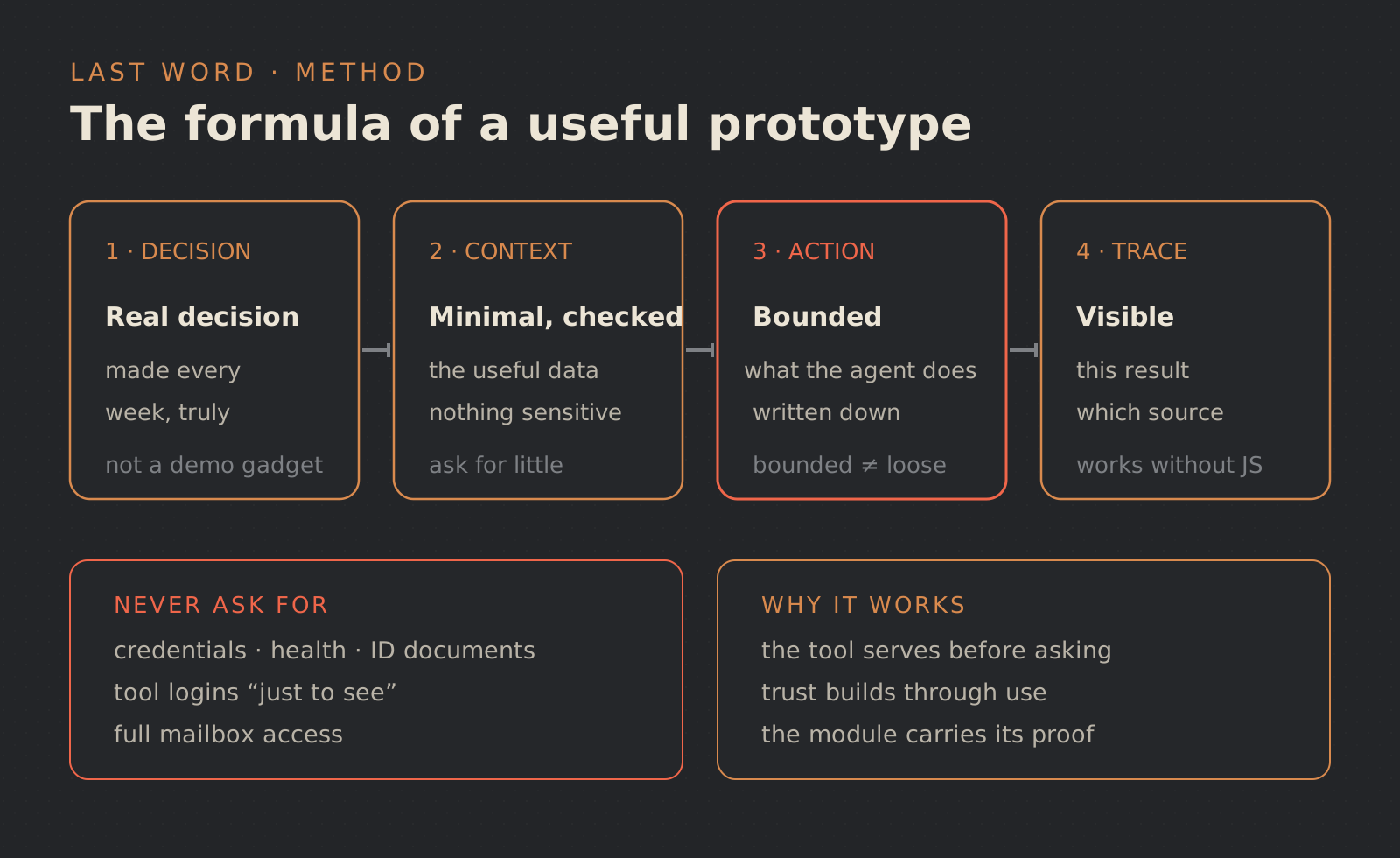
Useful prototype = frequent question + explainable rules + reusable output + visible limits + next action.
If one part is missing, the module becomes fragile.
- Frequent question: the visitor is already asking it.
- Explainable rules: you can say why the result appears.
- Reusable output: the visitor can copy, reread or share the result.
- Visible limits: the module does not pretend to know the full context.
- Next action: the page explains what to do after the result.
This formula avoids two mistakes: the gadget with no follow-up and the overambitious fake diagnostic.
Agentic does not mean uncontrollable
The word “agentic” can be worrying if it suggests a system that makes decisions on its own. On a website, the target should often be smaller: an agent that prepares, rephrases, classifies or suggests, with a closed scope.
Reasonable examples:
Prepare
The tool turns visitor answers into a structured brief. It does not promise an automatic quote.
Classify
It points toward AI agent, automation, scraping or web project according to visible criteria.
Compare
It places two options side by side: build, buy, wait, simplify the process.
Escalate
It indicates when the topic deserves a human diagnostic, especially with sensitive data or critical actions.
This is less spectacular than a universal assistant. It is also much more credible.
A crawlable fallback is mandatory
For SEO and answer engines, the value must not live only in JavaScript. The page needs a static version: grid, method, result examples, questions asked, limits.
A good prototype therefore has two layers:
- a visible and indexable editorial layer;
- an interactive layer that personalizes or accelerates the experience.
If the interactive layer fails, the page should still be useful. If it is invisible to crawlers, the content should still explain the reasoning. Otherwise you create a tool that may be interesting for the immediate user but less useful for search and harder to understand outside the interaction.
Data you should not ask for
A public prototype should not push visitors to share too much information. This is especially true for AI, internal data and automation topics.
Avoid by default:
- unnecessary personal data;
- contract excerpts;
- customer files;
- business secrets;
- access to tools;
- detailed financial information;
- names of end clients.
You can ask for general context: process type, approximate volume, tools used, sensitivity level, frequency, blocking step. Sensitive detail comes later, inside an appropriate framework.
The ideal path
An editorial prototype can follow a very short path.
Intro
Goal: State the promise and the limit Example: “This tool helps choose a direction, not produce a quote”
Questions
Goal: Collect just enough context Example: Workflow, frequency, risk, human validation
Result
Goal: Give an explained orientation Example: “Start with simple automation, not an AI agent”
Limits
Goal: Avoid false certainty Example: “To be checked against real data”
CTA
Goal: Offer a coherent next step Example: “Describe the process” or “view the service”
Each step should be short. If the prototype asks for ten minutes before producing anything, it becomes a disguised form.
Example: agent or automation selector
The visitor answers four questions:
- Is the workflow repetitive?
- Are the rules stable?
- Is the data accessible?
- Could a sensitive action be sent without validation?
Possible outputs:
- simple automation if the rules are stable;
- assisted agent if the context varies but the decision remains human;
- preliminary scoping if sources or responsibilities are unclear;
- temporary stop if risk is high and guardrails are missing.
This output is imperfect, but useful. It prevents selling an AI agent when automation is enough. It also shows how the provider thinks.
QA before publication
A web prototype needs stricter QA than a standard article.
| Check | Why it matters |
|---|---|
| Local build | Ensure the page and module do not break the site |
| Mobile | Forms and tables break quickly on small screens |
| No JavaScript | The page must retain editorial value |
| Console errors | A broken prototype destroys trust |
| Keyboard accessibility | Questions must be usable without a mouse |
| Data | Avoid collecting unnecessary or sensitive information |
| Results | Every recommendation must be explainable |
| CTA | The next step must match the result |
This QA takes time. That is normal. A poorly controlled mini-tool can do more damage than an average article.
Why it works as a content module
A prototype can strengthen a piece of content when it provides a reusable grid, method or diagnostic. The page is not only an opinion: it contains a tool, with visible rules and limits.
It does not replace the text. The text explains the frame, limits and use cases. The tool makes the frame concrete. Together, they create stronger content than a generic article about “AI for SMEs”.
Where to start
Start with a very restrained prototype: an AI use-case selector or a mini-brief generator. No user account, no database, no promise of automatic diagnosis. The goal is a clear, copyable output that helps the visitor express the need before moving to the next step.
If feedback shows that the module genuinely clarifies requests, it can be enriched. If not, simplify it. An editorial tool should serve the journey, not become a parallel product.
The value test for a prototype
- Output: the visitor leaves with something usable.
- Rules: the reasoning remains visible and challengeable.
- Fallback: the page still makes sense without interaction.
- Next step: the CTA matches the result, not manufactured urgency.
FAQ
Does an agentic web prototype have to use an LLM?
Not always. Some prototypes work better with simple, visible and maintainable rules. An LLM becomes useful for rephrasing, classifying free text or generating a brief, but it is not mandatory.
Is it good for SEO?
Yes if the method, criteria and examples remain crawlable. No if all the value is hidden inside a JavaScript component with no static content.
What should be the first prototype?
Choose a frequent question that appears before a commercial request. For an offer combining AI agents, automation and business scoping, a use-case selector is often more useful than a generic conversational demo.
How do you avoid bad recommendations?
Limit the scope, show the rules, add cautious results and provide a “needs human scoping” outcome when the information is insufficient or sensitive.