A local LLM can be a good choice. But it does not automatically solve compliance, security or quality issues. Most of the time, it moves part of the responsibility into your own system.
Instead of asking whether everything should run locally, ask what data the system will process, for what purpose, with which controls, and how much operational work the team can sustain. When scoping a local LLM with GDPR constraints or an AI agent, this keeps the architecture from being chosen before the need is understood.
Local deployment changes where data flows, not the whole compliance picture
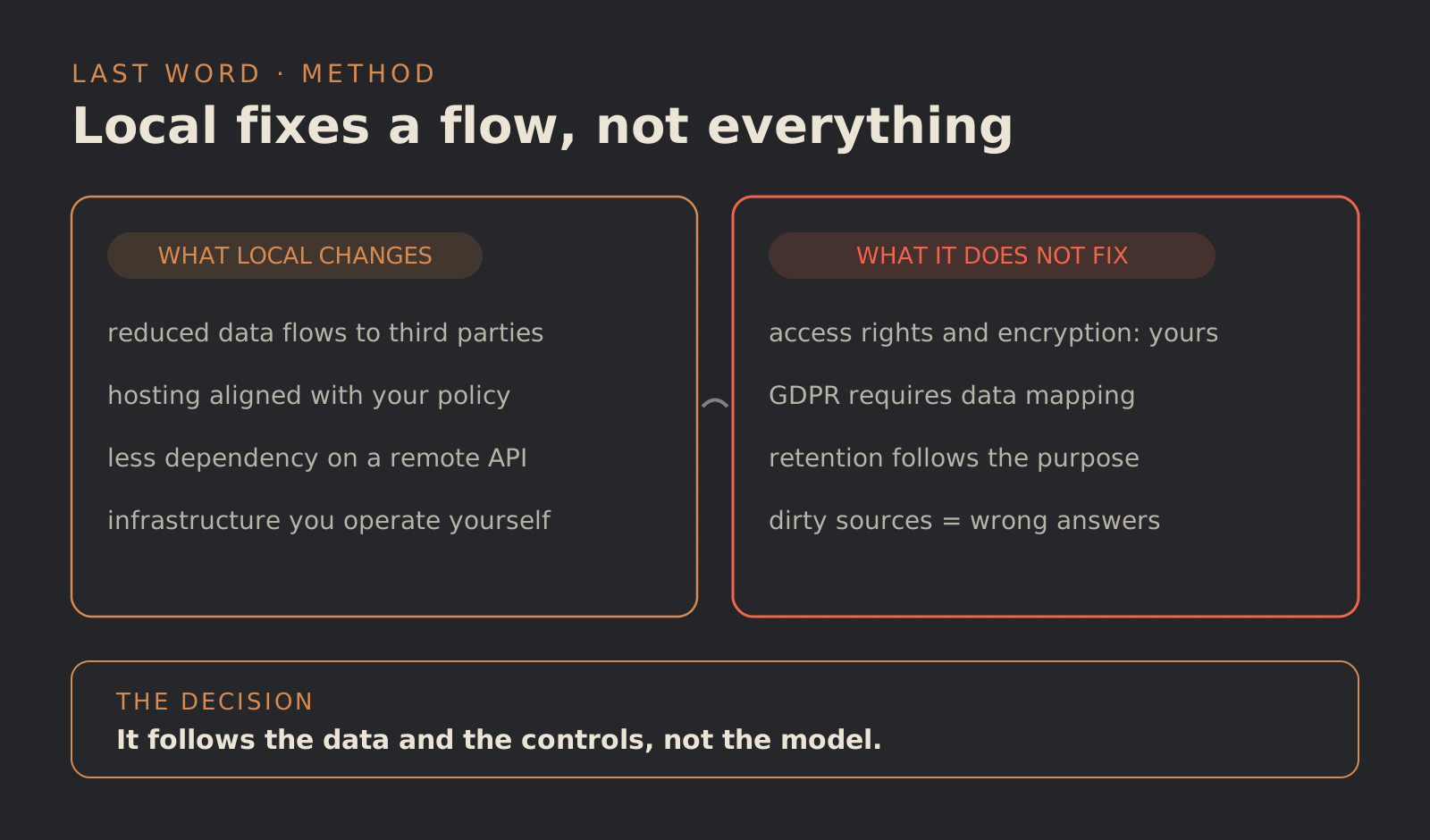
A local LLM can reduce data sent to third parties. It does not replace data mapping, access rights, logs or a retention policy.
The right trade-off
A local LLM can reduce some risks, but it does not solve GDPR by itself. For the development phase of a system that processes personal data, the CNIL's guidance highlights purpose, legal basis, data minimisation, access control and retention. The model is only one part of the architecture.
For sensitive use cases, map the data before choosing inference. Otherwise you optimise the wrong layer.
What a local LLM really changes
A local LLM can make sense when data is sensitive, when latency or offline use matters, when the team needs tighter control of the infrastructure, or when an internal policy limits external services. It is not enough when business rules are unclear, access rights are poorly defined, logs are missing or documents are not governed.
Local hosting is an architecture option. It is not a legal guarantee. The official GDPR text ties obligations to personal-data processing and its risks, not merely to the model’s location. Have the framework validated by the right people. This article helps you ask the right technical and operational questions; it is not legal advice.
The trap is treating “local” as a compliance stamp. It is not. A local model can reduce some transfers and give more control, but it does not decide who may see what, how long traces are kept, or how the team corrects a dangerous answer.
A hybrid architecture is often more practical: keep sensitive data within a controlled environment, use more capable external services for less sensitive tasks, and apply consistent logging, access rules and human review to outputs that commit the company.
How this differs from the agent articles
This article covers architecture and governance. For use case selection, start with AI agents for small businesses. For a support case, connect the architecture to the AI support agent brief.
What “local LLM” actually means
In practice, “local” can describe several different setups:
- a model running on a workstation;
- a model hosted on an internal server;
- a model deployed in a private cloud or controlled region;
- an open-weights model operated by your team;
- a model embedded in an application with no direct call to an external API.
These options do not have the same costs, risks or limits. Saying “we want local” is not enough. You need to clarify where the model runs, who administers it, what data enters the system, what outputs are stored and which tools are connected.
A local model without governance can be less safe than a well-scoped external service. The opposite can also be true. The right choice depends on context, not on an abstract preference.
When local can be useful
Local deployment is worth considering when it answers a concrete constraint.
Sensitive data
Local deployment can reduce some flows to third parties, but access rights, logs, encryption and retention still need to be managed.
Hosting rule
It satisfies an internal policy only if the team can actually operate the infrastructure.
Offline use
It reduces dependency on a remote API, with real deployment, update and support questions.
Variable cost
It can give more control over usage, but machine cost, maintenance and monitoring still count.
Local latency
It can reduce network round trips if the chosen model really meets the expected performance.
Technical auditability
It can make the chain easier to inspect, provided the application also traces sources, actions and access.
This list does not say local is better. It tests whether there is a concrete reason for it. If you cannot name the constraint, you may be choosing a solution before scoping the problem.
When local is not enough
A local LLM does not fix an obsolete knowledge base. It does not decide who is allowed to see what. It does not replace a data retention policy: the CNIL’s guidance on data collection and management says retention must follow the purpose and be planned and monitored over time. It does not make answers reliable when sources contradict each other.
Common mistakes include:
- assuming local automatically means compliant;
- giving the model access to too many folders;
- forgetting input and output logs;
- storing conversations without a rule;
- connecting business tools without validation;
- confusing anonymization, pseudonymization and simple masking;
- neglecting model and infrastructure maintenance.
The risk often sits in the application around the model. An agent can retrieve a document, compose an answer, call a tool, write to a CRM or send an email. Even if the model runs locally, every step must be scoped.
Where local can genuinely help
Before deciding, score each criterion from 0 to 2. The score does not replace a full analysis, but it forces the right conversations.
Data sensitivity
0: Public data 1: Internal data 2: Personal or confidential data
Hosting constraint
0: None 1: Internal preference 2: Strong rule or contractual obligation
Technical capacity
0: No internal operations 1: Partial support 2: Team able to maintain it
Performance need
0: Occasional use 1: Regular use 2: Integrated into a critical process
Document governance
0: Vague sources 1: Identified sources 2: Maintained sources with named owners
Connected actions
0: None 1: Suggested actions 2: Actions executed in business tools
Simple reading:
- low score: start by scoping the use case and the data;
- medium score: compare local, controlled cloud and external API options against the same requirements;
- high score: evaluate local closely, including operations and governance.
A high score is not an automatic recommendation. It mainly indicates that the topic goes beyond model choice.
Controls to plan for
A local project must remain operable. The basic controls are often the same as for an external architecture, but they are your responsibility. For the development phase, the CNIL’s guidance on securing an AI system starts with risk assessment and recommends access controls, logging and logical isolation for sensitive datasets.
Minimum checklist:
- inventory of processed data;
- clear user scope;
- access rights by source;
- separation between test and production;
- useful request and action logs;
- conversation retention rule;
- human validation for sensitive actions;
- shutdown or cut-off procedure;
- version tracking for model and prompts;
- tests with ambiguous cases and forbidden cases.
If this list has no owner, local deployment risks becoming a server that runs quietly until nobody knows how to audit it. That is not a good foundation for a system handling important data.
Quality: the model is only part of the subject
Local models can be very useful for classification, summarization, extraction or internal writing assistance. But their quality depends heavily on the use case, model size, source documents and expected output format.
For many projects, the right test is not a free conversation. It is a batch of representative cases: simple requests, ambiguous requests, incomplete documents, long formulations, out-of-scope cases. Then you look at the errors: invention, wrong source, excessive refusal, vague answer, incorrect extraction.
This test must use real constraints. If the local model does not have access to the right sources, it should not be asked to guess. If it only prepares an answer for human validation, the risk level is not the same as if it sends the message directly.
Compare without bias
An honest comparison puts every option on the same grid: data sent, data stored, operating cost, latency, quality, supervision, security, maintenance and reversibility.
Local can win on control of flows. It can lose on simplicity, performance or maintenance. An external API can be fast to test. It can be unsuitable if internal rules prohibit it. A private cloud can be a compromise. It can also be too heavy for a pilot.
Architecture should not become a matter of principle. Document the risks and choose the smallest scope that allows the team to learn without exposing the company unnecessarily.
Architecture starts with the data map
Before choosing local, cloud or hybrid, list the data that is actually touched: ticket, document, CRM, attachment, customer history, log. Only then can you decide where the model runs and which traces it keeps.
The test that avoids a reflex architecture choice
If you cannot name the data that must not leave, “local” is a slogan. If you can name it but cannot operate the setup, local becomes a burden. If you can name it, isolate it and test it, then the option deserves a proper evaluation.
Last Word can frame this decision through its services or as part of a broader AI support agent project.
Decide from the data, not from the model
- Sensitive data: identify what must not leave.
- Access rights: check who can read what before the agent does.
- Logs: know what is kept, where and for how long.
- Quality: test the model on your cases, not on a generic demo.
FAQ
Is a local LLM automatically GDPR-compliant?
No. The place where the model runs is not enough. You must examine the data, purposes, access rights, retention, security and governance. Have the framework validated by the right people.
Can we start with a prototype that does not touch sensitive data?
Yes, and it is often the right approach. A prototype on fictional or anonymized data can validate the workflow, response formats and limits before real data is processed.
Is local always more expensive?
Not always, but operations must be counted: machines, monitoring, updates, security, backups and technical time. The cost is not limited to the model.
Sources
Links checked on 25 August 2026. These references support technical scoping; they do not replace a legal assessment of the processing or advice from a qualified DPO or legal professional.
- Regulation (EU) 2016/679 (GDPR), official text, European Parliament and Council.
- AI system development: recommendations to comply with the GDPR, CNIL, synthesis and checklist published on 5 January 2026 for the development phase.
- Data protection in AI data collection and management, CNIL, 2 July 2024.
- Ensuring the security of an AI system’s development, CNIL, courtesy translation published on 5 January 2026 of the French guidance dated 22 July 2025.
The takeaway
Choose a local LLM for a precise reason, not for reassurance. Assess the whole chain: data, access, sources, logs, actions and responsibilities. Last Word can help scope that choice, then turn the scope into a testable prototype. To start without overpromising, share the context via contact.