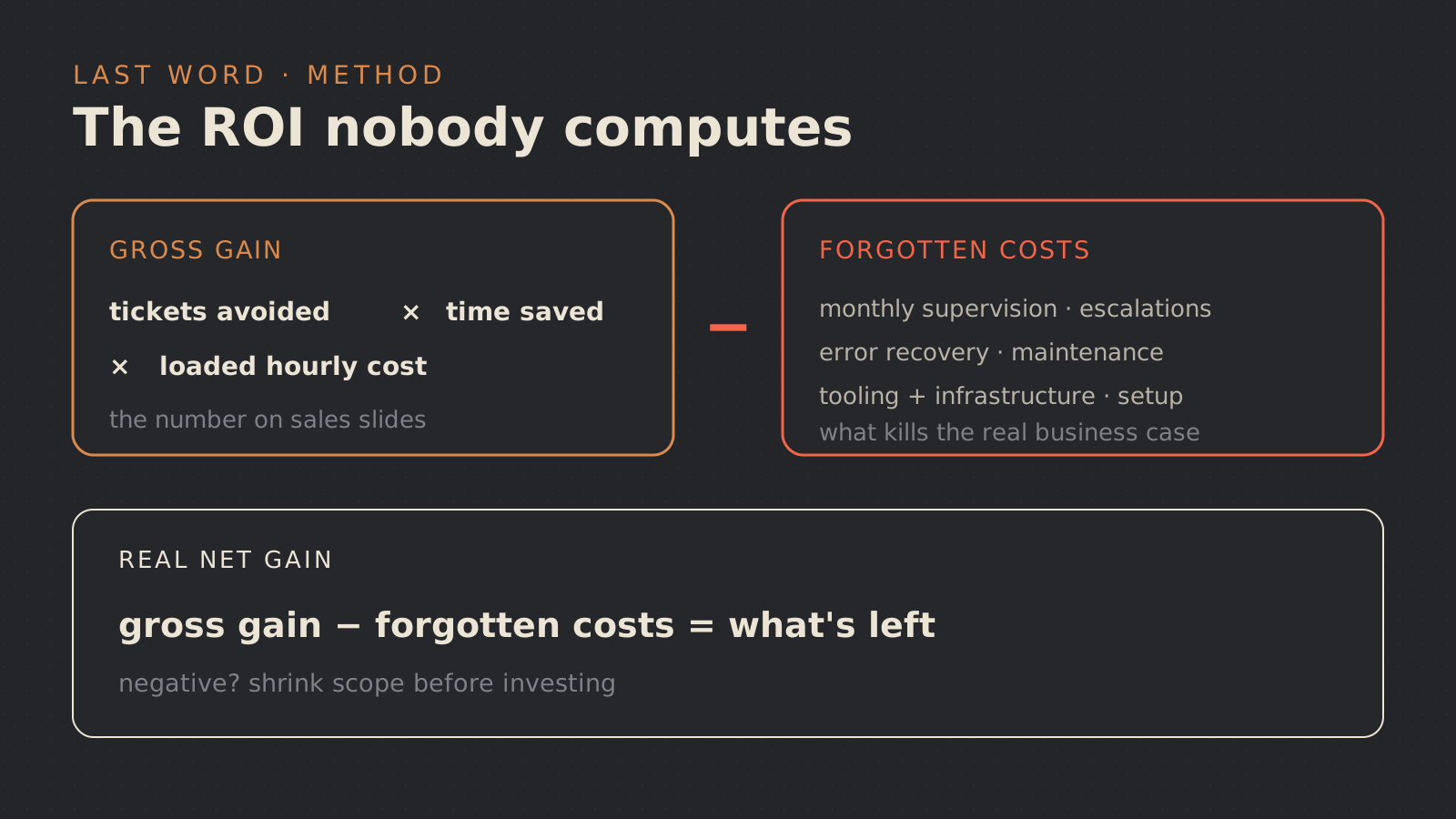
The ROI of an AI support agent is not calculated with a promise such as “80% of tickets automated”. It starts with a simpler question: how many human minutes are actually saved once supervision, escalations, errors and maintenance are subtracted?
A good support agent can save time. A bad calculation can also make a project look profitable when it only moves the work elsewhere. Here is a disciplined way to decide whether an AI support agent is worth building.
In short: useful ROI Do not measure “how many answers the AI generates”. Measure how many human minutes are actually saved, then subtract supervision, escalations, errors and maintenance.
Support ROI is calculated after looking at tickets, not before
The spreadsheet can become comforting very quickly. The real calculation starts with recurring tickets, costly tickets and tickets that can be prepared safely.
The honest calculation
The ROI of a support agent is better measured through the decisions it improves than through a magic number. Time saved, better-qualified requests, cleaner escalations and avoided mistakes say more than a cost-reduction promise.
Keep two columns: expected gains and added risks. If the second column is empty, the calculation is too optimistic.
The useful formula
The starting formula fits in three lines:
Monthly gross gain = automatable tickets × minutes saved per ticket × loaded cost per minute

Monthly net gain = gross gain - tool costs - supervision - maintenance - escalations - errors

Payback period = setup cost / monthly net gain
The formula is only valuable if the inputs are sober. Take a representative month, remove exceptional peaks, then group tickets by family. ROI rarely comes from the most visible tickets. It comes from repetitive requests where resolution is stable and a prepared answer truly saves time.
An honest calculation must also accept a negative conclusion. If net gain disappears once supervision and maintenance are added, that is not a failure. It is a useful way to avoid an unnecessary project.
How this connects to the cluster
This guide decides whether the project is worth the cost. To choose the solution type, go back to chatbot, AI agent or automation. To write the testable scope, use the AI support agent brief.
The key point: do not start from the number of conversations handled by AI. Start from the time genuinely removed from support work.
An agent that replies to many small messages without resolving the requests does not necessarily create value. An agent that handles fewer cases but avoids long searches or prepares a clean escalation may have a better ROI.
Variables to measure before talking about ROI
Before launching the project, take a normal month of support and measure the variables that actually change the result.
Repetitive volume
Number of requests by family and the share that can truly be automated. ROI depends on repetitive volume, not total volume.
Minutes saved
Reading, searching, writing, action and follow-up time. This is the real unit of value.
Loaded cost per minute
The full cost of a support minute: salary, employer costs, tools and management included.
Escalation and supervision
Share of cases transferred to a human, review time, correction and recovery. These costs can cancel the gain.
Maintenance and errors
Updating rules, sources, tests, workflows, corrections and the cost of lost trust when the agent is wrong.
If these data do not exist, start by classifying 100 to 200 recent tickets. This does not require a heavy audit: the aim is to identify frequent families, average handling time and cases to exclude.
Field signal If you do not have these numbers yet, the first deliverable is not an agent. It is a simple support map: families, volumes, average time, risks and escalation rules.
Crawlable mini-calculator
You can use this table as a first calculation. Replace the “to fill in” cells with your own data.
| Line | Formula | Value |
|---|---|---|
| Monthly automatable tickets | total volume × automatable share | to fill in |
| Minutes saved per month | automatable tickets × minutes saved | to fill in |
| Monthly gross gain | minutes saved × loaded cost per minute | to fill in |
| Tool / infrastructure costs | subscription, API, hosting, monitoring | to fill in |
| Human supervision | review minutes × loaded cost per minute | to fill in |
| Monthly maintenance | documentation, tests, fixes, rules | to fill in |
| Remaining escalations | escalated tickets × recovery time | to fill in |
| Cost of errors | corrections + estimated business impact | to fill in |
| Monthly net gain | gross gain - all costs above | to fill in |
| Payback period | setup cost / monthly net gain | to fill in |
This calculation is not here to sell a project. It is here to prevent projects that do not stand up.
Costs that business cases forget
Supervision
At the beginning, the agent must be reviewed. Someone checks responses, spots poorly covered cases, corrects rules and improves the knowledge base. That supervision is normal. It becomes a problem if it consumes almost all the time saved.
Maintenance
Offers change, processes evolve, bugs appear and customers ask new questions. Plan time to maintain the agent: sources, escalation rules, tests, tool connections and quality monitoring.
Escalation
A good agent does not pretend to solve everything. It knows when to stop. But a useful escalation must pass context along: request summary, sources checked, reason for transfer and action already attempted. Otherwise the human starts again from zero.
Errors
An error can be a wrong answer, a rushed action, misunderstood data or an unapproved promise. Even if you cannot price that cost perfectly, it must appear in the reasoning.
Which tickets should be automated first?
Start with request families where volume, stability and risk are readable. A good first target is not necessarily spectacular; it mainly avoids putting the customer relationship at risk.
Yes: documented frequent questions
Stable answer, low risk, quick gain if the knowledge base is maintained.
Yes, if the data is accessible
Order tracking, case status or simple administrative requests, with reliable sources and guardrails.
Partial: complex billing
Preparation is possible, but the final decision often remains human.
Partial: product bug
Triage and collection of useful information; full resolution is rarely handled by the agent.
Not autonomous
Disputes, very unhappy customers, legal or financial advice: the agent can summarise, not decide alone.
The first scope should be frequent, repetitive, low-risk and measurable. The point is not to automate all support. The point is to prove value on a clear slice.
Scoping decision The best first agent is not the one that covers the most tickets. It is the one that saves enough work on a scope stable enough to test without risking the customer relationship.
Calculate on real tickets
A generic spreadsheet is rarely enough. The right calculation starts from a ticket export, grouped families and a sample reviewed by the support team. Then you test the agent on profitable families, not on the entire inbox.
Before opening a calculator or asking for a quote, fill in this framing block. It catches the most common fake ROI: counting every AI-handled conversation as saved time while supervision, correction and escalation come back through the side door.
Fast diagnostic
The calculation starts with tickets, not with a promise
Pick one request family, then check whether the gain still exists once human control is added back in.
Recurring reason, monthly volume and real examples reviewed by support.
Search, writing, action and rework. Not just the displayed response time.
Validation, escalations, corrections, rule updates and monitoring.
The threshold where the project stops because net gain is too fragile.
If you want to turn that framing into numbers, use the AI support ROI calculator or share the ticket sample through contact.
Numbers to collect before promising ROI
- Volume: tickets by reason, not just the total.
- Time: real handling time with rework and searches.
- Risk: cost of a wrong answer or late escalation.
- Project effort: scoping, integrations, QA, supervision and maintenance.
FAQ chatbot, support agent or business automation?
Answer very simple questions
Often suitable solution: FAQ chatbot Why: Little context, documented answer.
Understand a free-form request and prepare a reply
Often suitable solution: AI support agent Why: Natural language and context matter.
Read several tools and propose an action
Often suitable solution: Framed AI support agent Why: Permissions and logs become important.
Synchronise two tools according to a fixed rule
Often suitable solution: Process automation Why: AI is not always necessary.
Run a repetitive internal workflow
Often suitable solution: [Process automation](/en/services/) Why: Value comes from reliable execution.
Often, the right system mixes both: an agent understands the request, then triggers or prepares a controlled workflow.
When ROI is poor
An AI support agent is not a priority if:
- volume is too low;
- requests are almost all unique;
- documentation is missing or contradictory;
- necessary data is inaccessible;
- nobody can supervise;
- errors are too costly for this starting scope;
- the support team does not yet have stable categories or rules.
In that case, start by structuring the knowledge base, tags, response templates, routing or a simple automation. It is less spectacular, but often more profitable.
How to test without a big project
A serious test can fit into two weeks.
- Choose one ticket family.
- Classify real examples.
- Write the rules: sources, actions, escalations, forbidden behaviour.
- Run the agent first as an internal assistant: it proposes, a human validates.
- Measure minutes saved, corrections, escalations and errors.
- Decide: expand, narrow, improve the data or stop.
Only after this test does ROI become solid.
FAQ
How do you calculate the ROI of an AI support agent?
Calculate gross gain using the volume of automatable tickets, minutes saved per ticket and loaded cost per minute. Then subtract tool costs, supervision, maintenance, escalations and errors. ROI should be based on net gain.
What ticket volume is needed to make an AI agent profitable?
There is no universal threshold. A small number of long, repetitive requests can be interesting. A high volume of sensitive or poorly documented requests can be a bad starting point.
Does an AI support agent replace the support team?
No. It removes repetitive work, prepares replies, speeds up searches and improves escalation. Humans keep sensitive decisions, customer relationships and continuous improvement.
What should be measured during the test?
Measure minutes saved, correction rate, escalation rate, errors, supervision time and feedback from the support team.
What to keep
Good ROI is not a promise. It is a measure of avoided work minus the cost of control.
If net gain is clear on a small scope, the agent is worth building. If the calculation remains vague, improve the process before automating.
To frame a first calculation on your own support flows, start with AI support agent or contact.