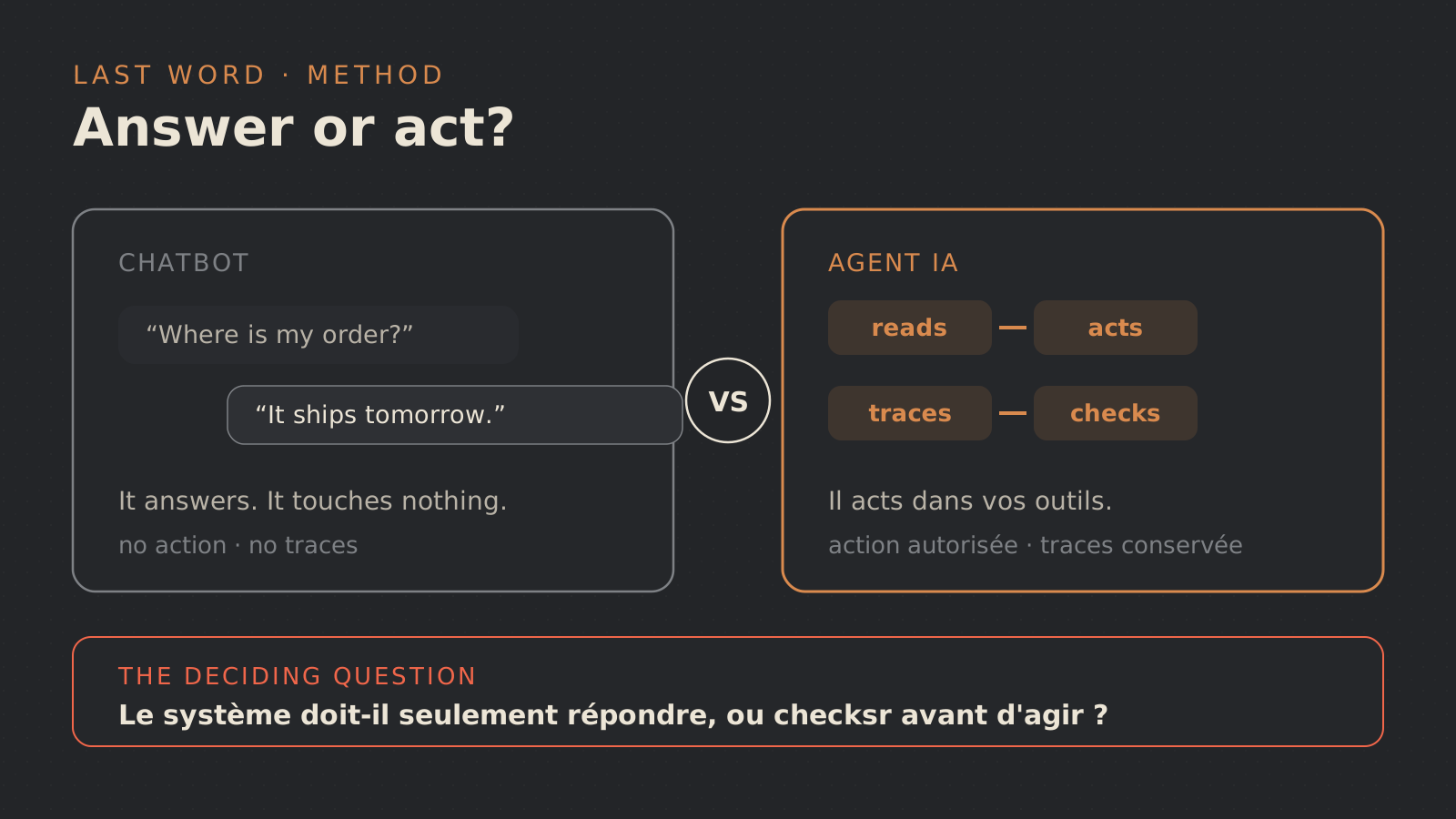
A chatbot answers a conversation. An AI agent reads context, chooses an authorised action, works inside a tool and leaves a trace. That is the difference that matters for a small business, not whether there is a chat bubble with a model behind it.
The risk today is that almost any AI interface is sold as an agent. To choose properly, look at four things: accessible data, possible actions, escalation rules and the level of risk the company is willing to accept.
Fast decision If the system only replies, it is probably a chatbot. If it can prepare or execute a controlled action inside a business tool, you are starting to talk about an agent.
Do not buy an agent when a better interface is enough
The useful distinction is not “chatbot or agent”. It is whether the system only answers, or whether it must check something before acting.
Last Word point of view
I use a simple rule: if the user needs a short, stable answer, a chatbot may be enough. If the system must read context, choose an action, leave a trace and ask for approval, you are designing an agent or a controlled automation. The difference is not vocabulary. It is the responsibility you give the system.
Before choosing a tool, write two real conversations and two exceptions. If the exception matters more than the standard answer, start with scoping.
The difference in one sentence
A chatbot mainly handles the exchange. It answers, guides, collects information or creates a ticket.
An AI agent handles part of the work. It interprets a request, checks data, prepares a decision, triggers an authorised action and stops when the case becomes risky.
The question is not whether the tool “uses AI”. The question is what responsibility you give it. Answering a question is not the same as changing an order, promising a refund, prioritising a ticket or preparing a sales follow-up.
This distinction protects the project. It prevents you from overpaying for a chatbot sold as an agent, but it also prevents you from building a system with too much freedom when the team only needed a better FAQ or a form connected properly to the CRM.
Do not confuse this with the two neighbouring guides
This article draws the “chatbot vs agent” boundary. To choose between chatbot, agent and deterministic workflow, use chatbot, AI agent or automation. To pick the first concrete use case, go back to AI agents for small businesses.
This is not a theoretical distinction. It changes the budget, QA effort, access rights and the way results are measured.
What a chatbot does well
A chatbot is still useful when the need is stable: opening hours, frequent questions, routing to the right page, simple qualification, information collection before transfer.
It is especially relevant when:
- the answers are known;
- the risk of error is low;
- no sensitive action is triggered;
- the user accepts a guided interaction;
- the team wants to reduce repetitive questions, not transform a process.
A good chatbot can improve support. Problems begin when it is asked to solve cases that depend on customer history, an invoice, a live status or a business rule.
What an AI agent adds
An AI agent becomes interesting when the request does not arrive in a clean format. It must understand intent, retrieve reliable data, choose between several paths and produce a usable output.
Example: a customer writes, “I can’t find my March invoice.” A chatbot can explain the procedure. An agent can identify the customer, search for the invoice, verify the address, prepare the email, attach the document and log the action. If the customer also disputes the amount, it escalates.
The value comes less from the generated sentence than from the system around it: permissions, sources, logs, validation and recovery when something goes wrong.
Six situations that cut through the demo
Answer an FAQ
Chatbot: Good fit AI agent: Often excessive
Collect information before a ticket
Chatbot: Good fit AI agent: Useful if routing is complex
Read a free-form email and classify it
Chatbot: Limited AI agent: Good fit
Retrieve customer data
Chatbot: Fragile alone AI agent: Good if access is controlled
Modify business data
Chatbot: Avoid AI agent: Possible with validation
Handle a dispute or refund
Chatbot: No AI agent: Assistance only; human required
Do not ask which tool sounds more modern. Ask which responsibility you can delegate without losing control. That one question often kills a polished but useless demo.
The hidden costs are different
A chatbot costs mainly in content maintenance: up-to-date answers, a clean decision tree and well-routed transfers.
An agent costs in control engineering: access, guardrails, tests, logs, supervision and edge-case correction. It is heavier, but also more useful when volume and complexity justify the effort.
Field signal A poorly framed agent costs more than an honest chatbot. The right project starts with the scope, not with the ambition.
How to test before buying
Take 30 real requests. Not perfect examples written for a demo: actual emails, tickets or conversations, anonymised if needed.
Classify them into three groups:
- stable answer;
- simple action with a clear rule;
- variable or risky case.
If 80% of the requests fall into the first group, start with a chatbot or a better-structured answer base. If many requests require data checks or actions inside a tool, an agent deserves a closer look.
Common mistakes
The first mistake is putting a chatbot in front of a broken process. If the data is unreliable, the conversation will simply become smoother on the way to a wrong answer.
The second is promising autonomy without defining escalation. An agent must know how to say “I stop here”. Otherwise it becomes dangerous exactly where the company needs caution.
The third is measuring only the number of conversations handled. The real indicator is the number of cases correctly resolved, prepared or escalated.
The sentence to write before buying
Before asking for a demo, write this sentence: “We want the system to be allowed to ___, but never to ___ without human validation.”
Then test it against three real requests. If the first blank stays empty, you probably need a chatbot or a knowledge base. If the second blank stays empty, you are opening too much risk. In both cases, a scoping workshop is better than another tool subscription: talk through the real case.
A useful mini-workshop
Take one simple ticket, one ambiguous ticket and one forbidden ticket. For each one, write what the system answers, what it reads, what it may do and where it must stop. If that sheet fits on one page, you can compare chatbot, workflow and agent without letting the vendor make the project bigger than it needs to be.
A fast filter before buying
- Chatbot: frequent questions, stable answer, low context.
- Automation: deterministic rule, repeated action, little ambiguity.
- AI agent: variable context, bounded decision, trace required.
- Human: dispute, commitment, commercial exception or legal risk.
FAQ
Can a chatbot become an AI agent?
Yes, but only if you add reliable sources, bounded actions, access rights and escalation rules. Connecting a newer model to a chat bubble is not enough.
When should a small business start with a chatbot?
When the answers are stable, low-risk and already documented. If the main need is to answer the same questions better, a chatbot or a structured knowledge base is usually the right first step.
When does an AI agent become relevant?
When the request requires context, a data check or a prepared action inside a tool. At that point, the project needs an AI support agent brief more than a conversational FAQ.
How Last Word would frame it
At Last Word, the right trade-off is usually progressive: chatbot when conversation is enough, workflow when the rule is clear, AI agent when the system needs to interpret and act under control. For a first scope, connect that choice to a method for building an AI agent and to AI workflows with human review.
If you are choosing between the three, describe the process, the available data and the actions you would like to delegate. We can help you choose the right level through custom projects or contact.