The right first AI agent is rarely the most impressive one. It is the one that removes a real operational friction, uses data you can actually access, carries limited risk and keeps human validation in the right place.
If you start with the tool, you will lose time. If you start with a precise business problem, the agent becomes easier to design, test and maintain. At Last Word, this is the approach behind AI support agent and process automation projects.
The first agent should be small enough to survive contact with reality
If the first AI agent already needs ten tools, three teams and sensitive data, it is not an MVP. It is an organisational redesign wearing a prototype costume.
Where I would start
For a small business, the best first agent is rarely the most ambitious one. It removes a visible friction without touching the core of the business: email triage, draft preparation, file summarisation, completeness checks. The gain is modest, but it exposes data quality and review discipline quickly.
Pick a workflow where mistakes are reversible. Two weeks on a small real scope will teach you more than three months of architecture diagrams.
A useful definition of an AI agent
An AI agent is not just a chat interface. In a small business, it is a system that reads context, chooses an authorised action, performs that action in a tool, then leaves a trace that the team can understand.
A simple example: an agent receives a customer request about an invoice. It identifies the customer, checks the invoice status, drafts a reply, attaches the right document if the rules allow it, and asks for human validation when the case falls outside its scope.
Before drawing an architecture, name the exact work the agent should relieve. Not “put AI in support”. More like: prepare a billing reply, match a request with a contract, classify an ambiguous ticket, or restart a blocked case with the right context.
That modesty is intentional. A first agent is a learning system for your data, rules and team habits. If the first scope holds, you can extend it. If it does not, a more ambitious agent would only have failed more expensively.
Keep the reading path sane
- If you are still comparing a conversational interface with an action system, start with AI agent vs chatbot.
- If the topic is customer support, move next to the AI support agent brief.
- If budget approval matters, use the support ROI method.
- If data sensitivity drives the project, check local LLMs and GDPR before choosing infrastructure.
So the first question is not “which model should we use?”. The first question is: which task deserves interpretation, a controlled decision and a useful action?
Useful filter The best first agent is not the one that looks the smartest. It is the one the team can correct, measure and stop without stress.
The selection matrix for a first agent
Score each criterion from 1 to 5. A good first use case does not need to be perfect, but it should score at least 4 on business value and at least 3 on available data.
Business value
Question to ask: Does the task consume time or reduce quality? Bad signal: Nice to have Good signal: Frequent pain
Available data
Question to ask: Can the information be accessed? Bad signal: Scattered Good signal: Sources identified
Risk
Question to ask: Could an error be expensive? Bad signal: High risk Good signal: Limited risk
Repetition
Question to ask: Does the case happen often? Bad signal: Rare Good signal: Frequent
Possible action
Question to ask: Can the agent do something useful? Bad signal: Only answers Good signal: Reads, prepares, triggers
Validation
Question to ask: Can a human stay in the right place? Bad signal: Unclear Good signal: Clear control point
If risk and complexity are high, keep that case for later. The first agent should prove the method, not carry the whole company.
Use cases that often work first
Good candidates share one trait: the business team can already explain the rule, even if nobody has formalised it cleanly yet.
Reasonable examples include:
- pre-qualifying inbound requests;
- preparing support replies before validation;
- sorting tickets and routing them to the right person;
- extracting information from recurring emails or PDFs;
- summarising customer files before a meeting;
- monitoring a source and alerting the team when it changes.
These are not spectacular use cases. That is fine. A useful agent often looks like a very rigorous colleague working on one narrow part of the job.
Use cases to avoid for a first project
Avoid agents that must decide alone on sensitive topics: major discounts, disputes, HR data, contractual commitments, data deletion, legal answers. They may assist, prepare and check, but they should not decide without guardrails.
Also avoid the large internal general-purpose agent. “It will answer every question from the team” sounds attractive, but it often hides three problems: documents are not ready, access rights are unclear, and nobody knows how to measure answer quality.
For a first project, a narrow agent that works is better than a universal assistant nobody fully trusts.
A five-step implementation path
1. Scoping
Deliverable: use-case brief Exit question: what is the agent allowed to do?
2. Data
Deliverable: source and access list Exit question: where does it read reliable information?
3. Prototype
Deliverable: testable workflow Exit question: can it process 20 real cases?
4. Business QA
Deliverable: error log Exit question: which mistakes keep appearing?
5. Limited production
Deliverable: agent with logs and validation Exit question: who monitors and corrects it?
Testing on 20 real cases avoids demos that only work on three hand-picked examples. Use recent requests, imperfect formats and edge cases. That is when the project becomes serious.
The minimum starting brief
Before building, write one page with these elements:
- business objective in one sentence;
- users involved;
- authorised data sources;
- authorised and forbidden actions;
- criteria for escalating to a human;
- log format;
- test method;
- validation owner.
If this page is hard to complete, the issue is not technical. The scope is not ready. That is useful: you have just avoided a vague project.
How to judge the first agent
A successful agent is not judged by how elegant its answers sound. It is judged on four things: it handles the right scope, knows when to stop, leaves traces, and can be improved by the team.
The healthiest early metric is simple: on a batch of real cases, how many were prepared correctly, how many needed a minor correction, how many were escalated, and how many produced a blocking error?
Do not invent spreadsheet ROI before you have that log. Measure behaviour first. The financial calculation will come later, with less fragile data.
Move from idea to a testable first case
The right deliverable is not a spectacular demo. It is a one-page scope: targeted task, available sources, authorised actions, escalation thresholds, test batch and stopping criteria.
If you want to move without AI theatre, Last Word can frame that first scope with you: describe the need or start from the AI support agent offer on the services page if the case is support-related.
The test before saying yes to a first agent
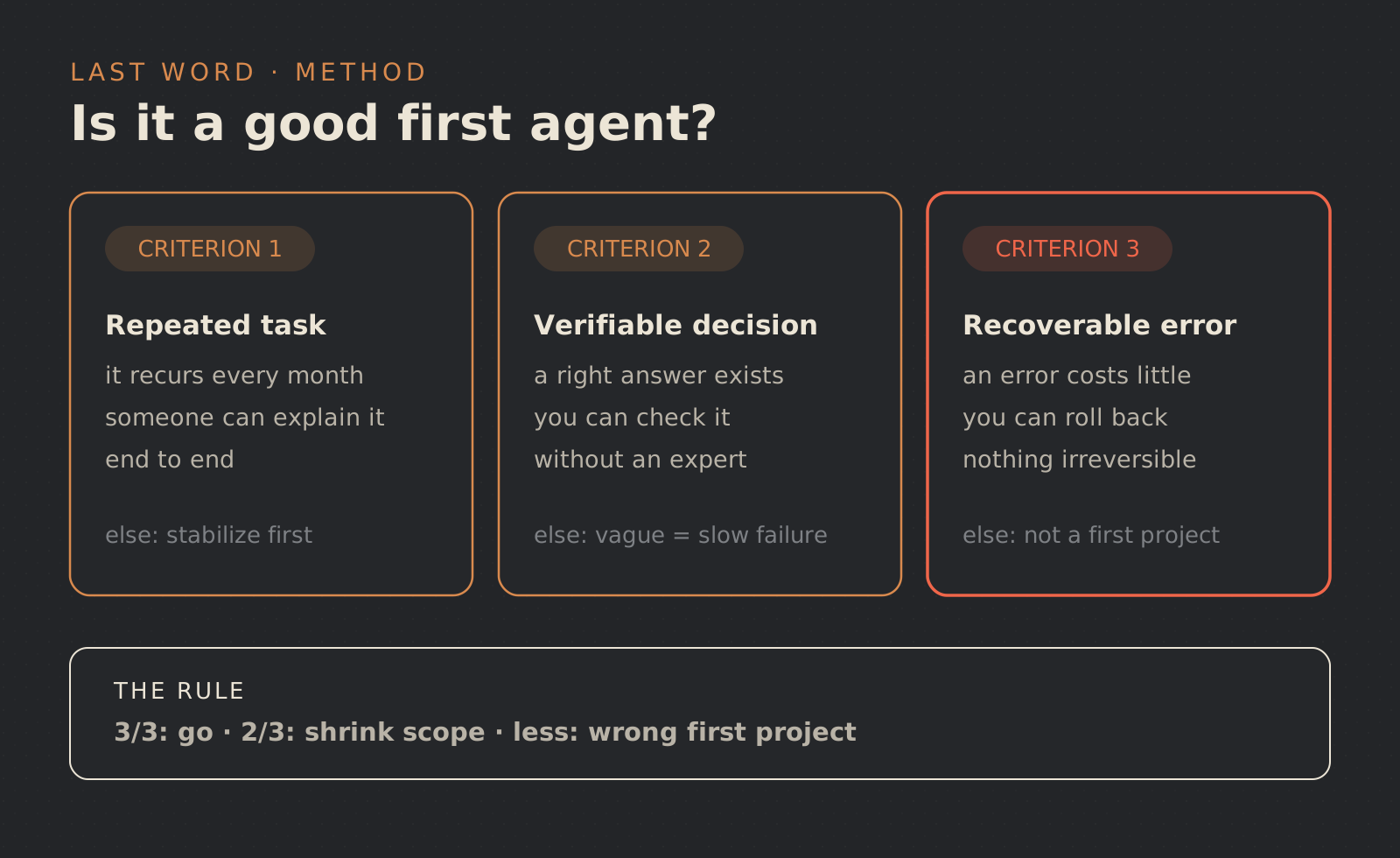
- One owner: someone can tell whether the output is right.
- Reversible action: the agent prepares, classifies or suggests before committing.
- Real cases: testing uses recent requests, not polished demos.
- Stop rule: the team knows when to pause, correct or go manual.
FAQ
Does an AI agent need to connect to all our tools?
No. For a first project, two or three well-chosen integrations are often enough. Every connection adds permissions, possible failures and maintenance.
Should we start with a customer chatbot?
Not necessarily. Many small businesses gain faster from an internal agent that prepares work for the team. Customers may never see it, but response quality improves.
Can we build an AI agent without perfect data?
Yes, but not without identified data. The agent must know which source is authoritative. Otherwise it compensates with plausible text, which is exactly what you want to avoid.
The right starting point
Choose a repeated, bounded task that the team already understands, with a useful but reversible action. Build small. Test on real cases. Keep a human at the sensitive decision point.
If you want to scope that first case without spreading the project too wide, Last Word can help turn a vague idea into a controllable prototype. The simplest entry point is the contact page, with two or three processes you would like to delegate.