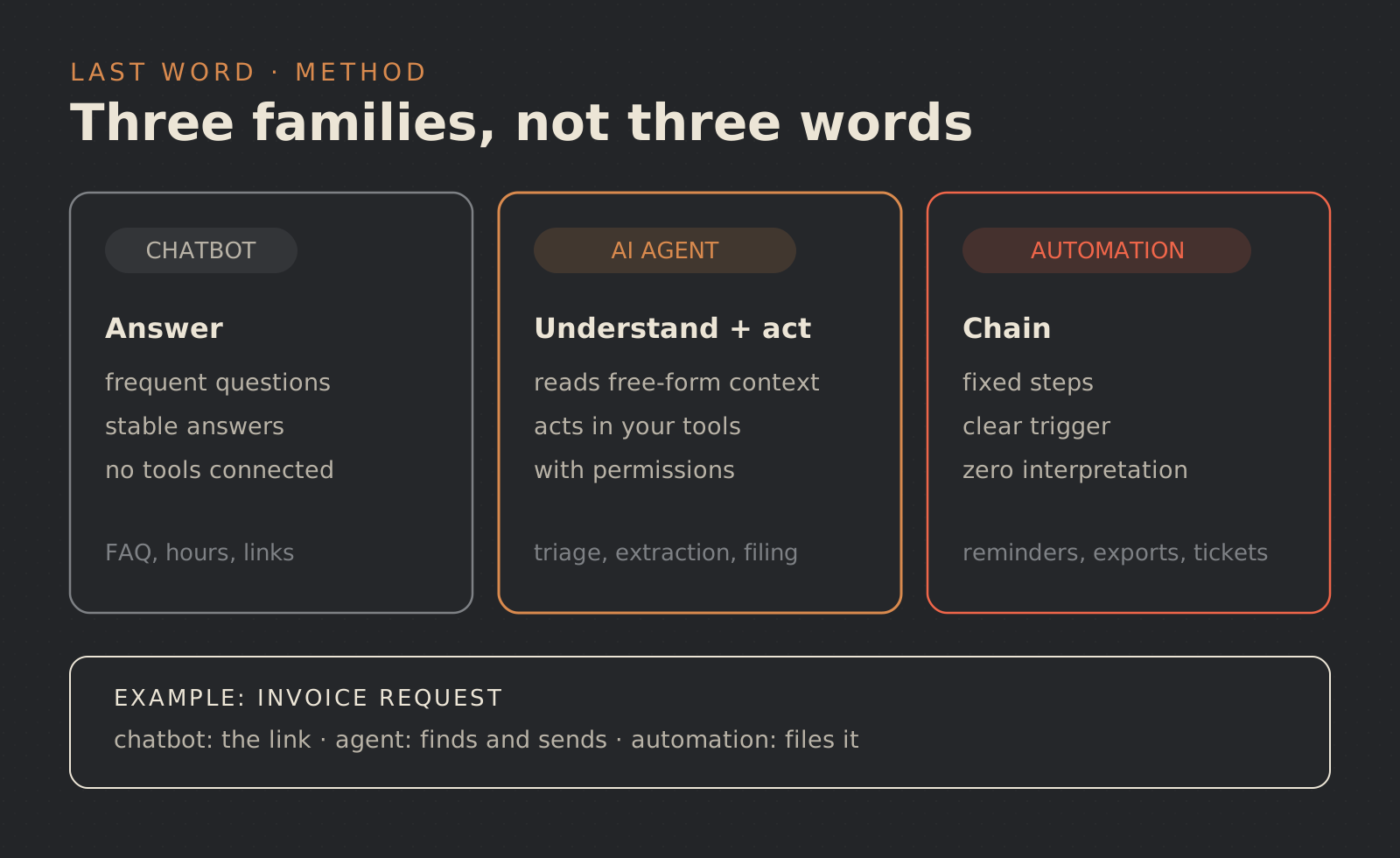
A chatbot answers. A workflow executes a rule. An AI agent combines context, a controlled decision and action. The boundary is not always perfectly clean, but it is clear enough to avoid many bad projects.
The trap is calling anything with a language model an “AI agent”. That ambiguity is expensive: you buy a chat interface when you needed to automate a process, or you build an agent with too much freedom when a well-designed form would have been enough.
Use this article as a sorting grid before choosing between an AI support agent, process automation or a custom web tool.
Simple rule Do not choose the most marketable word. Choose the level of responsibility the system can carry without becoming dangerous.
The right choice is often less ambitious than the demo
If the need fits into three stable rules, start with automation. If the answer depends on live context, then you can talk about an agent.
The sober decision
The right choice is not always the smartest-looking one. A good form can beat a chatbot. A simple automation can beat an agent. An agent becomes useful when context varies enough to justify the cost of control.
Ask first: who decides, based on which information, and what happens if the system is wrong? The answer usually points to the right format.
The three families
The chatbot
A chatbot is useful when users ask predictable questions. It can guide, answer an FAQ, collect information and create a ticket.
Its main role is to manage a conversation. It should not be sold as a full automation solution if it does not modify any business tool or make any real decision.
The automation workflow
A workflow follows deterministic logic: if this event happens, then this action is triggered. It is very effective for clear rules: send a notification, create a CRM row, rename a file, route a request according to a category.
Its main role is to execute without improvising. When the rule is stable, it is often better than an AI agent: cheaper, more predictable and easier to audit.
The AI agent
An AI agent becomes relevant when the system must interpret variable context before acting. It can read an email, extract intent, verify data, choose between several paths, prepare a reply and ask for validation when the case leaves the rules.
Its main role is to handle variation inside a controlled frame. It is not there to replace simple rules. It is there when rules alone become too rigid.
Decision matrix
Frequent questions and stable answers
Chatbot: Good choice Workflow: Useful in the background AI agent: Often excessive
Repetitive task with a clear rule
Chatbot: Weak Workflow: Good choice AI agent: Unnecessarily complex
Written requests with variation
Chatbot: Limited Workflow: Limited alone AI agent: Good choice
Need to act in a business tool
Chatbot: Possible but fragile Workflow: Good if the rule is clear AI agent: Good if context varies
High risk or sensitive decision
Chatbot: Avoid alone Workflow: With validation AI agent: With strict guardrails
Need for logs and audit
Chatbot: Medium Workflow: Good AI agent: Mandatory
Simple reading: if the rule fits in a stable decision tree, start with a workflow. If the conversation is the product, use a chatbot. If the system must understand imperfect requests before choosing an action, consider an AI agent.
The matrix is not meant to classify a tool forever. It prevents the first mistake. The same journey can contain all three bricks: a form captures the request, a workflow applies simple rules, an agent prepares ambiguous cases, then a human validates anything that binds the company.
In practice, clean systems are rarely “all agent” or “all no-code”. They are short chains: each component carries the responsibility it can handle, and nothing more.
How this differs from the neighbouring guides
Here, the goal is to choose the solution family. To build a support agent, use the AI support agent brief. To check whether the agent is worth the money, use the support ROI method.
Example: invoice request
Take a classic request: “Hello, I can’t find my March invoice. Could you send it again?”
A chatbot can ask for the customer email, provide a procedure or create a ticket.
A workflow can automatically send an invoice if the customer clicks inside a logged-in account and the invoice exists.
An AI agent can read the email, identify the customer, find the March invoice, check that the email address matches the account, prepare the reply, attach the document and log the action. If the customer also asks to change the amount, the agent stops and escalates.
The same apparent need hides three system levels. The right solution depends mainly on action rights and risk.
The six-question test
Before choosing, answer without jargon:
- Does the user mainly need an answer or an action?
- Is the business rule stable?
- Does the context arrive in a clean format or free text?
- Which data source is authoritative?
- What error would be acceptable?
- When must a human take over?
If you cannot answer questions 4 and 6, do not start development yet. The project lacks guardrails.
Quick filter
Use this formula as a filter:
Solution type = conversation + rule + variation + action + risk- Strong conversation, weak action: chatbot.
- Weak conversation, strong rule: workflow.
- Strong variation, useful action, controlled risk: AI agent.
- High risk, no validation: none of the three should act autonomously.
This formula is not scientific. It slows the decision before you buy a tool that is too broad.
Mistakes that usually cost money
The first mistake: adding AI to make a bad process look modern. If nobody knows who validates, where the reliable data is, or which action is authorised, the agent will not solve the problem. It will make it harder to diagnose.
The second: confusing autonomy with absence of control. A good agent is not free. It has permissions, thresholds, error messages, logs and an escalation procedure.
The third: using a chatbot as a cover-up. If the customer asks a simple question but the answer depends on a real status inside your business tool, an FAQ is not enough. The system must read the data.
The scoping sheet to fill in
Before discussing tools, fill in six lines. They often rule out the wrong option.
- Source of truth: where is the reliable data, and who maintains it?
- Authorised action: what can the system do alone, prepare, or only suggest?
- Forbidden cases: what kind of request stops the flow immediately?
- Trace: what must be kept so the team can understand a decision two weeks later?
- Real tests: which anonymised tickets or emails will break the polished demo?
- Business owner: who arbitrates the rule when automation hesitates?
Map before connecting automation
The most useful deliverable is often a map of the existing workflow: inputs, decisions, exceptions, touched tools and people who validate. Only then should you decide what belongs to a chatbot, an automation or an agent.
If your process already works but is fragile, start from the services page or send the real case through contact.
The sentence to write before the quote
- Predictable question: chatbot or assisted FAQ.
- Repeated action: simple monitored automation.
- Variable context: bounded AI agent with logs.
- High risk: human in front, AI prepares only.
FAQ
Can a chatbot become an AI agent?
Yes, if it gains access to data, actions and decision rules. But it is not an automatic evolution. Permissions and QA must be redesigned.
Can a workflow use an AI model?
Yes. For example, to classify an email before triggering a rule. In that case, the model is a workflow component, not necessarily a full agent.
Should we always aim for an AI agent?
No. For a stable rule, a simple workflow is often better. An agent becomes interesting when variation makes rules alone too heavy.
The right decision
Do not choose a technology. Choose a level of responsibility. The chatbot talks, the workflow executes, the agent interprets and acts under control.
If your case is unclear, Last Word can help translate it into a simple architecture: chatbot, automation, agent or nothing for now. You can describe your process through the contact page.