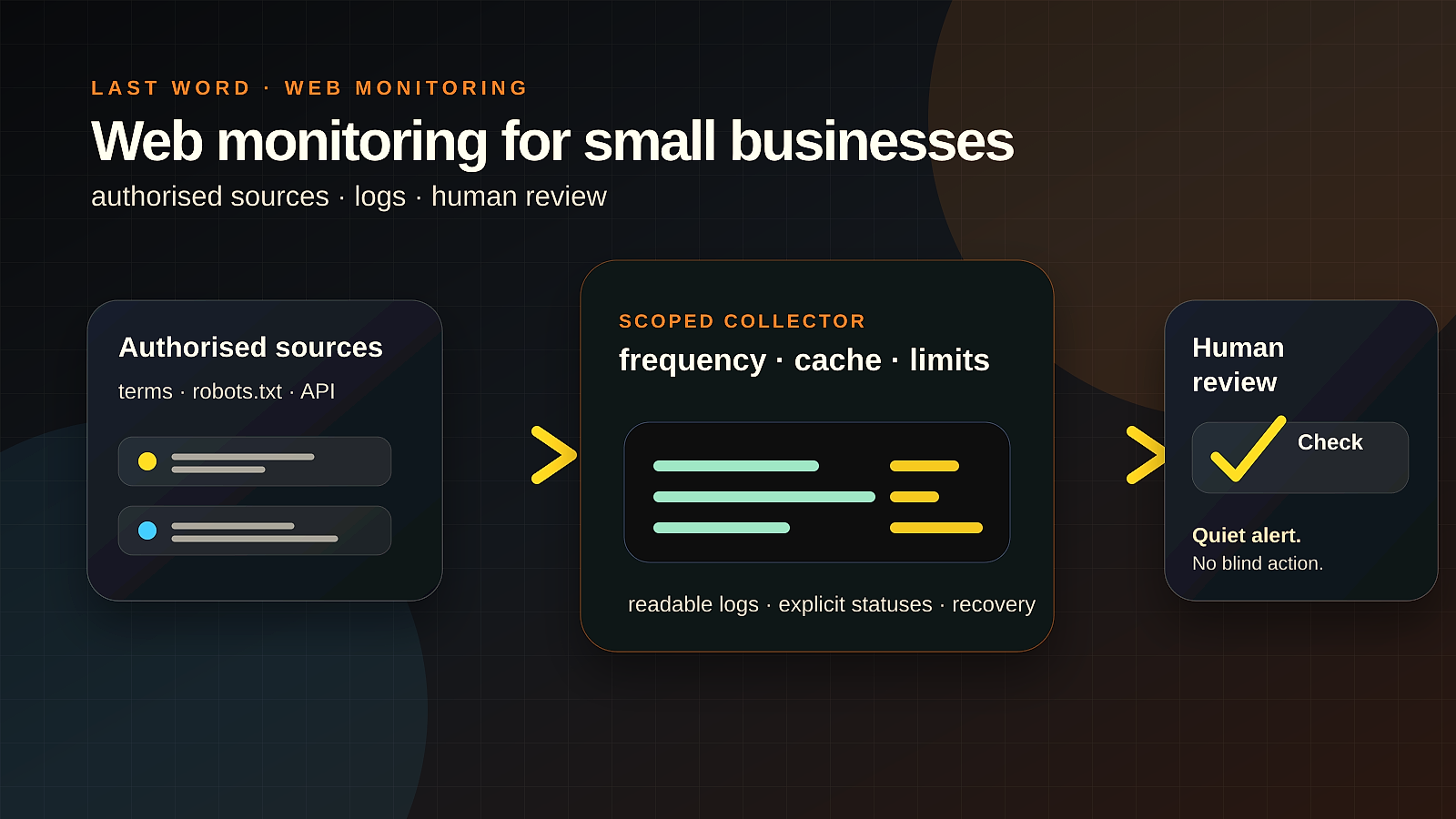
A small business rarely needs to “scrape the web”. It usually needs something narrower and more useful: watch a few important sources, detect what changed, keep the trace, and let the right person decide what to do next.
That is a very different project from a fragile script running in the background. Good web monitoring starts with a business decision: what becomes faster, safer or less annoying if this page is checked properly?
Once that is clear, the technical choices become easier: authorised sources, reasonable frequency, cache, readable logs, explicit error statuses, a simple dashboard or alert, and human review for anything sensitive. Without that framing, scraping becomes a pile of shortcuts. A selector breaks, a field disappears, an alert looks confident when it should not, and nobody knows whether the data can still be trusted.
When web monitoring is actually useful
Web monitoring helps when information is already available through pages, feeds, exports or other legitimate access paths, but is too scattered or too changeable to follow by hand.
Reasonable examples include:
- watching product, price or availability pages from authorised sources;
- checking whether a document, form or reference page has changed;
- following public tenders, listings or announcement pages;
- detecting updates across a small set of operational sources;
- consolidating weak signals into a business dashboard;
- preparing a weekly human review instead of rereading the same pages again.
The value is not the extraction itself. The value is the workflow around it: source checked, date, change detected, field missing, confidence level, human decision.
It is also important to know when not to scrape. If a source clearly forbids the intended use, if the data is sensitive without a proper framework, if the access is private and not meant for automated reuse, or if an API, export, RSS feed or direct agreement exists, the cleaner path should come first. A useful monitoring system is not the one that collects the most. It is the one the business can defend, maintain and act on.
Five questions before collecting a page
Before building anything, scope each source. A vague source produces a vague system.
1. What decision does this source prepare?
The first question is not “can we fetch the page?”. The first question is: what will someone do if it changes?
If the change does not trigger a review, a priority, a correction, a note, a customer action or an internal decision, collection will mostly add noise. One source tied to a clear decision is more valuable than twenty pages collected “just in case”.
2. Is the source accessible and authorised for this use?
Check the terms of use, access rights, robots.txt where relevant, crawl guidance, account conditions, contract terms and the type of data involved. A page visible in a browser is not automatically free for every automated use.
For EU businesses, GDPR also matters when personal data is collected or reused. The practical questions are purpose, legal basis, minimisation, retention, security, information duties where applicable, and rights management. This article is not legal advice; it is a reminder to frame the risk before production, especially when monitoring could affect people.
3. Which fields are really needed?
A robust scraper does not keep everything. It extracts the fields that support the decision: title, reference, price, status, date, source URL, availability, document version, category, confidence, comment.
Each field needs a rule: required, optional, sensitive, ignored, human-verified or never stored. This prevents a common failure: collecting raw text for weeks, then discovering that nobody can compare it, explain it or cleanly delete what should not have been stored.
4. How often should the source be checked?
Not every page needs hourly monitoring. Frequency depends on the real update rhythm, business impact, load placed on the source and the team’s ability to handle alerts.
For many small-business cases, daily, weekly or on-demand checks are enough. Excessive frequency creates logs, errors and alerts without improving the decision.
5. Who reviews the alert?
An alert without an owner becomes another inbox problem. Before automating, decide who receives what, in which tool, with which context and what action is expected.
The right format is not always email. It may be a dashboard row, a Slack notification, a task in an internal tool, a clean CSV export or a weekly review page with changes grouped by priority.
A simple source brief
Before the first prototype, a source brief keeps the scope honest:
| Item | Question to answer |
|---|---|
| Source | Which page, feed, API or export is actually useful? |
| Permission | What do the terms, access rights, robots.txt, crawl rules or agreements say? |
| Data | Which fields are necessary, sensitive, optional or intentionally ignored? |
| Frequency | What rhythm is enough to decide without overloading the source or the team? |
| Owner | Who validates alerts, fixes errors and decides whether to expand or stop? |
This brief is not a legal assessment. It simply makes assumptions visible before code is written.
Frequency, cache, logs and errors: the minimum robust setup
A serious web monitoring project does not need a heavy architecture. It needs a few safeguards that prevent silent failure.
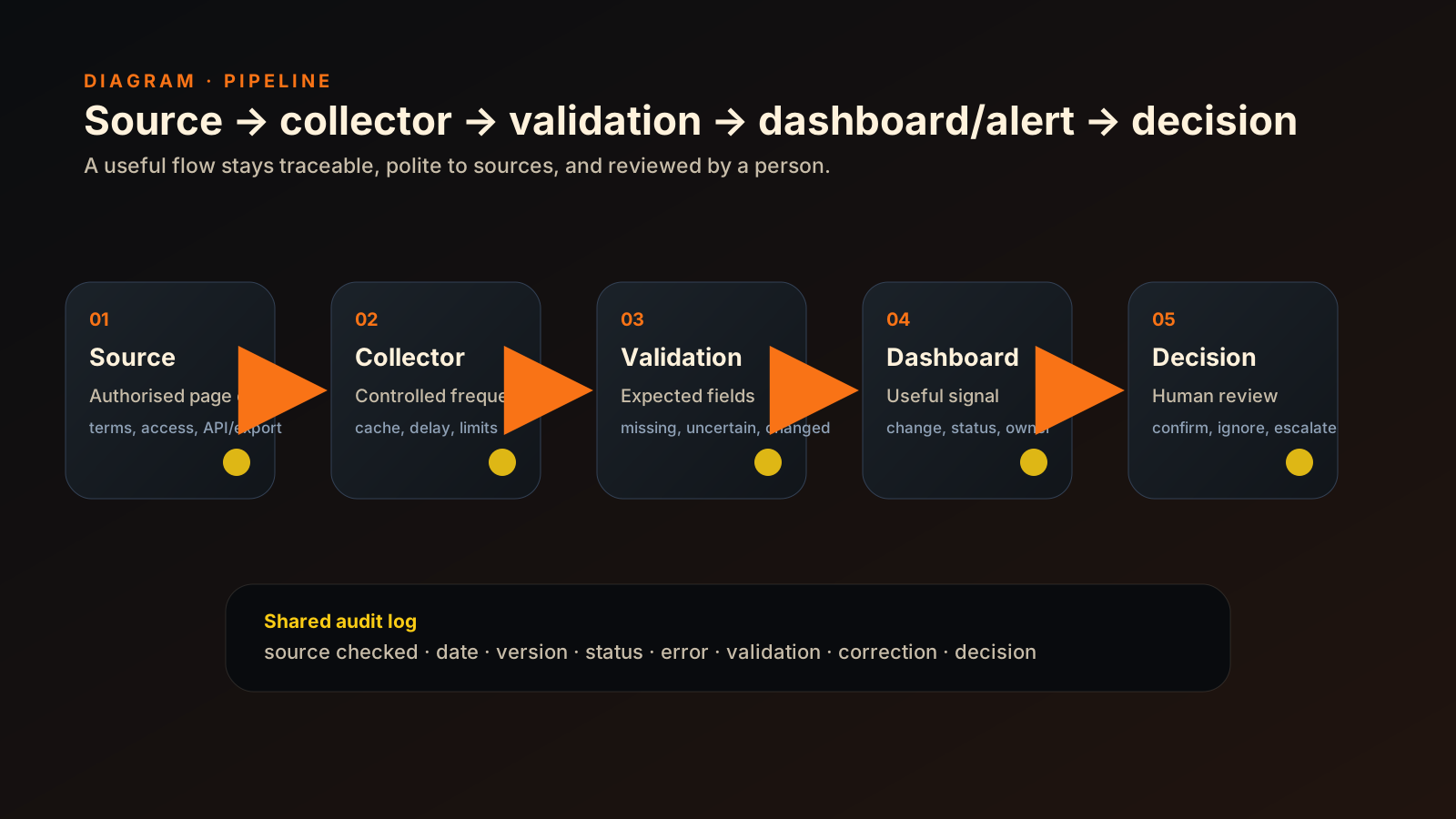
The collector retrieves the source. Validation checks that expected fields exist and that the data still looks like what was expected. The dashboard shows what changed, what is missing and what is uncertain. The human decides.
Four elements often separate a useful system from “it works on my laptop”.
A cache
Cache prevents unnecessary reloads, makes comparison possible and helps diagnose problems. It can be simple: timestamped raw content, page fingerprint, last structured result or a limited history.
Readable logs
Logs should answer simple questions: which source was checked, when, with what result, which error, which missing field, which alert, which human correction.
Explicit error statuses
An unavailable page should not become an empty value. A missing field should not be invented. Ambiguous content should not be displayed as confirmed.
Useful statuses include ok, source unavailable, missing field, format changed, needs review, human corrected, intentionally ignored.
A recovery procedure
Pages change. Selectors break. Formats move. Robustness does not mean promising that nothing will ever fail. It means detecting failure early, explaining what broke and preserving trust in the rest of the dashboard.
EU and GDPR caution before production
Scraping is not universally “legal” or “illegal”. The risk depends on the source, data, purpose, access rights, collection method, storage and use.
For a small business, the safe operating posture is cautious:
- check the source terms and access conditions;
- check
robots.txtand public crawl guidance where relevant; - look for an API, export, feed or direct agreement first;
- avoid technical circumvention;
- keep frequency reasonable;
- minimise collected data;
- avoid storing unnecessary personal data;
- document purpose and retention;
- identify a human owner;
- review sensitive cases before production.
This does not replace legal advice. It prevents a bad shortcut: “it is public, so we can automate any use”. Public visibility, reuse rights, personal-data rules and business purpose are separate questions.
In a Last Word project, this framing comes before the build. If the risk is too high, the better recommendation may be a limited manual check, a partner API request, a direct agreement, a non-sensitive document watch or dropping the source.
From data to decision: alert, dashboard, human review
Monitoring becomes useful when data is turned into a possible decision.
A business dashboard does not need to be complex. It should make visible:
- the source;
- the last check date;
- the detected change;
- the previous and current state where useful;
- the confidence level;
- the reason for the alert;
- the expected action;
- the trace of human validation.
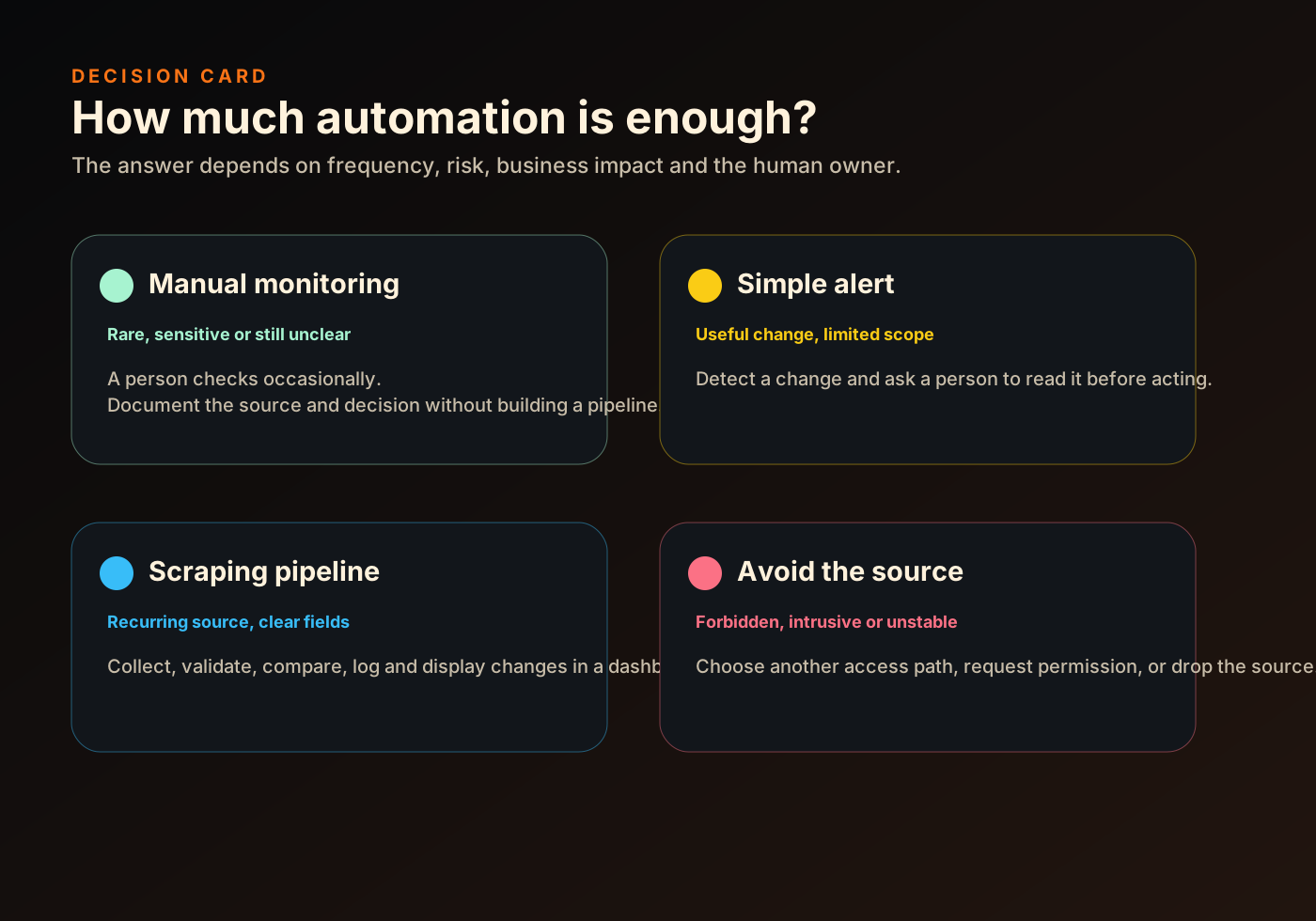
AI can help after the monitoring flow is clean. It can summarise a change, classify a signal, match similar labels or prepare a short review note. But AI does not fix bad scoping. If the sources are poorly chosen, rights are unclear or alerts have no owner, the model only makes the disorder look more polished.
A compact risk matrix
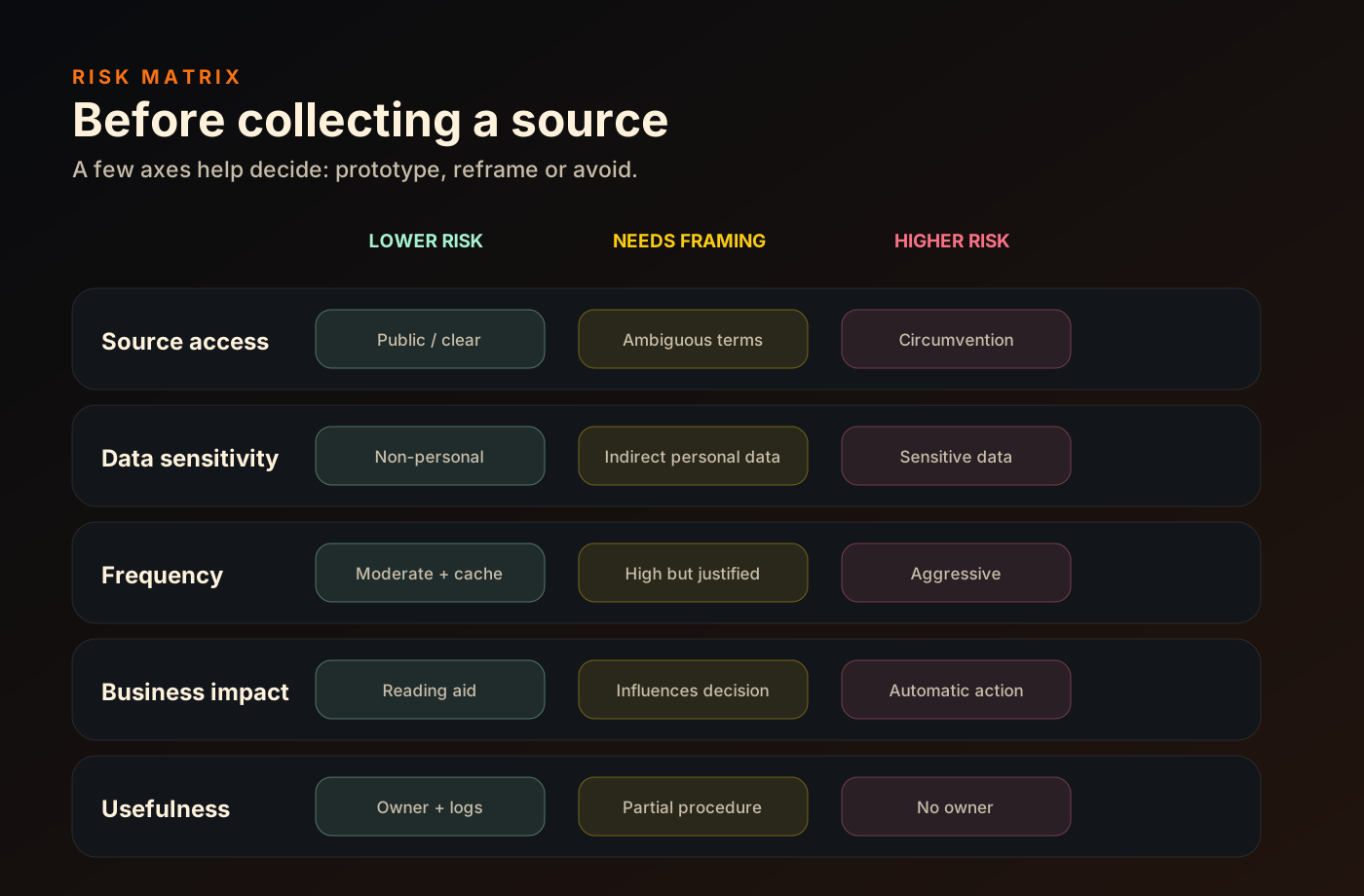
| Question | Lower risk | Needs framing | Higher risk |
|---|---|---|---|
| Source access | Public page or clear contractual access | Ambiguous terms, volume to limit | Circumvention or private access not meant for this use |
| Data sensitivity | Non-personal, low sensitivity | Indirect personal data or sensitive business context | Sensitive personal data or intrusive use |
| Frequency | Moderate checks with cache | High frequency but justified | Aggressive requests without justification |
| Business impact | Reading aid or prioritisation | Alert may influence a decision | Automatic action without validation |
| Usefulness | Owner identified, readable logs | Shared owner, partial procedure | Nobody knows what to do with the alert |
The matrix does not give a legal answer. It helps decide whether the project can enter a prototype, must be reframed, or should be avoided.
FAQ
Is web scraping legal?
There is no universal answer. You need to look at the source, terms of use, access rights, data type, purpose, frequency and storage. If personal data is collected or reused, GDPR may apply. For sensitive cases, get a legal review before production.
How many sources should we start with?
Often two or three well-chosen sources are enough for a prototype. The goal is to learn: is the source stable, are the fields reliable, are alerts useful, does the team know what to do with changes?
What happens if the page changes?
The system should detect the issue, show an error status, keep the last reliable value and notify the owner. Page changes are not exceptional in web monitoring. They are a normal situation to plan for.
Do we need AI for web scraping?
Not always. For structured pages and simple fields, a classic collector is often enough. AI becomes useful when content is less regular: summarising a change, matching labels, qualifying a signal or helping read a document. It should not invent missing data.
Where Last Word can help
Last Word designs web scraping and business monitoring workflows for small businesses that need to follow useful sources without building a risky homemade system. The work can start with a small prototype and expand into a dashboard: source framing, collection, validation, logs, alerts, visualisation and recovery.
If the monitoring touches internal workflows, human validation or operational dashboards, it can connect to a broader process automation or supervised agent project. For a related pattern, read the article on AI agents for business operations dashboards.
The right first conversation is not “how many pages do you want to scrape?”. It is: which sources do you already monitor, which decisions depend on them, and where do you lose trust today?