An AI agent incident is the moment a live agent takes a wrong, oversized or unrequested action — while still being technically healthy. It answers, it calls its tools, its status page says green. And somewhere in the business, a record was updated incorrectly, an email left the drafts folder, a report landed with the wrong recipient.
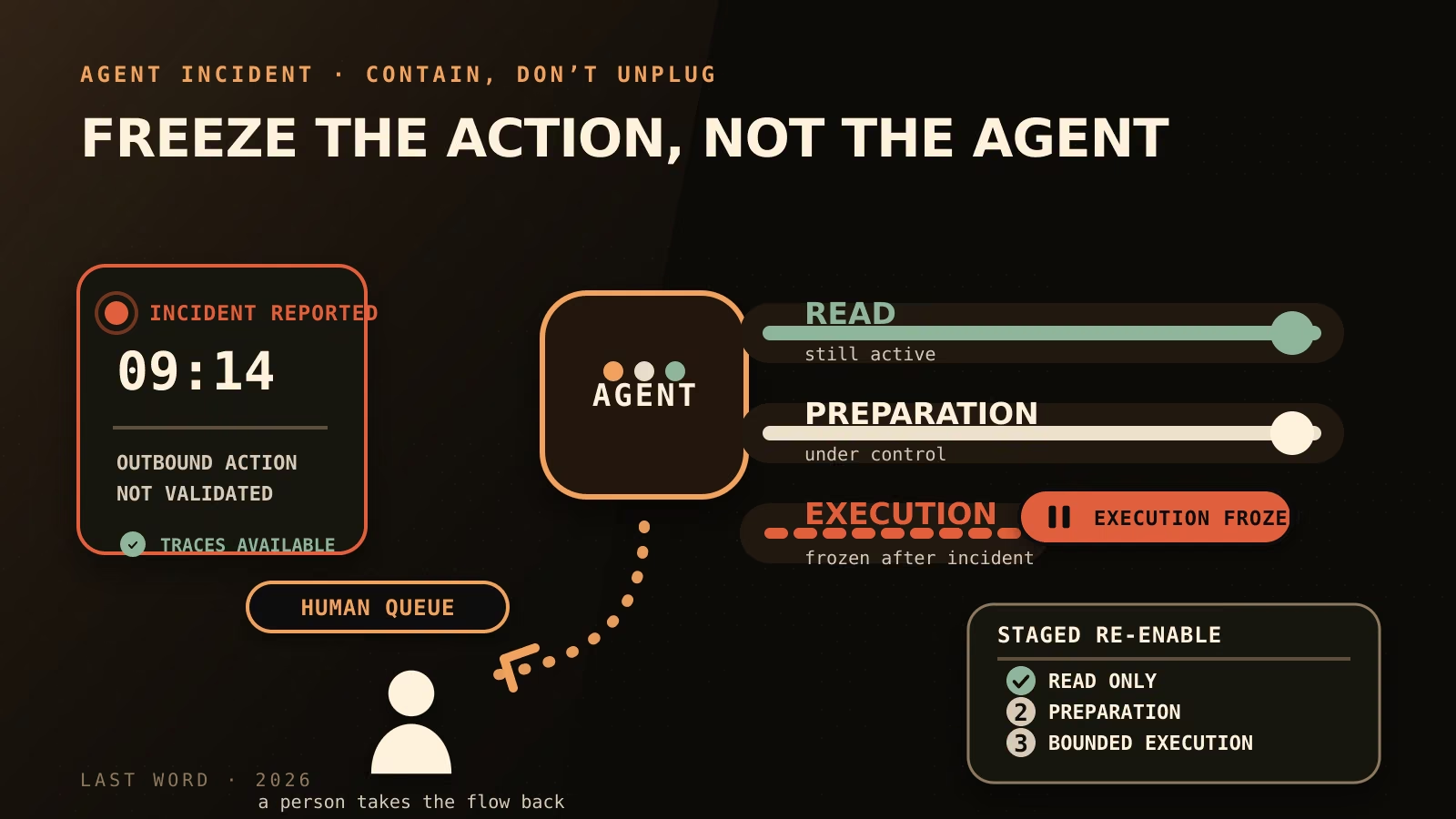
The right first move is neither “switch everything off” nor “wait until we understand”. It is a short sequence: shrink the agent’s blast radius, qualify what actually happened from the traces, fall back to a human queue, fix the cause, then re-enable autonomy in stages. This article walks that sequence, hour by hour, for an operations owner who does not have a dedicated platform team.
An agent incident doesn’t look like an outage
A classic outage is visible: the service stops responding. An agent incident is quieter, because the agent stays available and keeps producing effects that look normal. Operations runbooks describe exactly this profile: the wrong tool called, an action prepared against too wide a scope, a validation bypassed, a costly loop, quality drift after a model or prompt change.[1][2]
Fictional examples, but typical:
- a triage agent files a quarter of inbound requests under the wrong category after a source changed format;
- a record-keeping agent updates a field across an entire folder instead of one record, because the filter was too broad;
- a drafting agent sends a finalised email to an external recipient when its instruction was to prepare, never send;
- a reporting agent re-runs the same extraction in a loop and feeds a report full of duplicates.
In all four cases the agent is never “down”. It is still an operational incident: wrong data now exists, people saw things they should not have, and trust in the automation just took a hit.
That is why the kill-switch reflex is expensive: it destroys the value of everything the agent was doing correctly, without undoing anything already produced. And the opposite reflex — waiting for full understanding before acting — lets the agent keep producing effects with the same defect. The workable answer sits between the two: shrink the scope, immediately, without taking the whole thing offline.
The decision the first hours exist for
Contain without switching everything off, qualify from traces, fall back to humans, fix, then re-enable in stages. In that order. Reversing it — fixing before qualifying, or re-enabling before fixing — rebuilds the same incident.
The first thirty minutes: contain, don’t unplug
Containment means reducing what the agent can do, not deleting it. Three moves, in this order:
- Remove the tool involved. If the incident came from the email-sending tool, remove that tool from the agent — not the agent from the system. Triage, reading and drafting keep working.
- Drop to read-only. When the exact origin is still unknown, the agent keeps the right to read and analyse and loses the right to write. Operations runbooks describe this as the controlled degradation worth aiming for: the agent stays useful in assistance while sensitive capabilities are reduced.[2]
- Freeze outbound actions. Send, publish, pay, create, delete: everything that produces an external effect is suspended until qualification is done.
In parallel, map the blast radius: which records were touched, which recipients received what, over what period, at what cost if any. You map it from existing traces, not from gut feel. If the agent has no usable traces, write that down — it is debt to settle afterwards, and AI agent observability deserves its own project in that case; this article assumes some traces exist.
One immediate precaution: delete nothing. The incorrectly modified records, the sent emails, the raw logs are your evidence. Archiving comes before cleaning.
Qualify before you fix
Once the agent is contained, the question is no longer “how do we repair” but “what exactly happened”. AgentOps runbooks make it a rule: diagnose the action before any rollback, by rebuilding the full chain — which source was used, which tool was called, under which identity, in which scope, with which parameters, and what validation was expected.[2]
Rebuild that chain end to end, event by event:
- the source: what data did the agent read? Was it current, complete, in the expected shape?
- the decision: what did it conclude, and on what basis?
- the tool: was the right tool called, or a workaround tool?
- the parameters: were the filter, the recipient, the scope consistent with the instruction?
- the identity and rights: which permissions was the agent running with? Were they justified for this task?
- the validation: was a human review expected? Was it bypassed, or did the agent legitimately have the right to proceed alone?
Out of that chain comes a classification, and the classification determines the response — not intuition. A recovery playbook is explicit about this: a prompt rollback does not fix an over-permissioned tool; a model rollback does not fix a stale source; a restart does not fix a bypassed validation.[1] Patch the wrong layer and the cause stays alive; the incident comes back.
Two classic qualification traps:
- a fluent answer is not proof of success. An agent can confirm an action convincingly while the real effect differs from the announced one; the trace is the authority, not the tone;[1]
- the absence of an error return is not proof of failure. An action may have committed while the agent never received the receipt — replaying blindly creates duplicates.[1]
Fall back to a human queue without losing the thread
While the agent is contained, the business process keeps running: inbound requests arrive, cases pile up. The manual fallback needs to be organised, not improvised.
The mechanism is a human queue: everything the agent no longer processes enters an explicit queue, with a named owner and a processing order. Three rules keep it clean:
- Keep the entry points. Requests still land in the same place; nothing is lost during the incident.
- Separate finished from in-flight. List what the agent genuinely completed before containment — trace in hand — and what was left half-done. A half-processed case is more dangerous than an unprocessed one.
- Do not replay blindly. On resumption, check the real state of every item before touching it: did the announced action actually happen? The duplicate risk — redoing what was already done because the confirmation is missing — is documented as one of the central pitfalls of recovery.[1]
Where the human checkpoint should sit in the workflow, in normal times, deserves its own discussion — that is the subject of our article on human review in AI workflows. In an incident, you run the emergency version: everything goes through a human, temporarily.
Undo, compensate, or own it
Once the damage is bounded, you deal with the effects already produced. Three families, and sorting them changes everything:
- Reversible: the effect can be directly restored. The wrongly edited record gets its original value back, the misfiled requests get re-filed. You restore, verify, archive the proof.
- Compensable: the effect cannot be undone, but an explicit action neutralises it. The email that went to the wrong recipient cannot be recalled: you send a named correction, you notify, you log it. This is the mechanism the Saga pattern formalises in distributed architecture — when a step fails or goes off-script, a compensating transaction undoes what the already-committed steps did; some operations are marked compensable, others form irreversible pivots, others are simply retryable.[4]
- Irreversible: the effect is final. You own it: notify the people affected, document what was seen or sent, fix the cause so it does not happen again.
The reflex to lose: believing in a global “undo”. There isn’t one. What exists is an explicit corrective action — sent by a human, owned, logged. The reversible / compensable / irreversible sort happens record by record, not in bulk; a single incident can mix all three.
Fix the real cause
The fix targets the layer identified during qualification — and only that one, first:
- stale or changed source: reconnect the right source, bound what the agent may infer from it;
- wrong or over-permissioned tool: remove or restrict the tool, reduce rights to the minimum the task needs;
- too-broad parameter: tighten the filter, the scope, the recipient list;
- ambiguous instruction: rewrite the instruction for the case that failed, and for its cousins;
- regressive model or prompt version: go back to the previous version — which assumes it exists.
That is the hard part: you cannot roll back what you never versioned. Prompts, instructions, exposed tools, permissions and model versions must be versioned for a targeted rollback to be possible at all.[1][3] If your agent has no version history, the fix will be artisanal — doable, but slow, and the next incident will be just as slow to correct.
A regression test should follow the fix: replay the case that failed, as a fictionalised scenario, and verify the defect is gone without creating new ones. This is exactly what a pre-production evaluation protocol does — the difference is that here, the test case comes from the real incident, de-identified. A superficial fix — restart, “tighten things a bit” without identifying the faulty layer — leaves the cause alive. The classification done during qualification is your guarantee that you are fixing the right thing.
Re-enable autonomy in stages
The question that always arrives too early: “can we turn it back on?” The honest answer is in stages, based on evidence, not on restored confidence. Runbooks that have been through this moment describe the same progression:
- Read-only. The agent reads, triages in shadow mode, prepares proposals with no write rights. You compare its proposals against what the human queue produced.
- Preparation. The agent prepares actions — drafts, proposed updates — but nothing goes out without human approval.
- Bounded execution. The agent executes, on a reduced scope, on reversible actions first. The scope widens again as evidence accumulates, not as the team feels reassured.[2]
The re-widening criteria get written before reactivation: how many shadow-mode cases without deviation, which error families observed, who signs the next widening. Without written criteria, the decision gets made in fatigue, right after a busy Monday morning — that is how second incidents happen.
Turn the incident into a permanent guardrail
An incident contains a free lesson: it showed you a defect no demo would have revealed. Three conversions beat any decorative postmortem:
- the lesson becomes a test. The real case, de-identified, joins the regression library. The next version of the agent will be judged on it;
- the symptom becomes an alert. Whatever let you detect the incident — a user, an after-the-fact check, luck — should now surface automatically. That instrumentation work belongs to AI agent observability;
- the cause becomes a removed permission. If the incident was only possible because the agent held a right it never needed, that right does not come back. Human review gets placed at the right point in the workflow for that family of actions.
If the incident traces back to external content carrying instructions — an email, a page, a document that steered the agent off its instruction — the risk family is indirect prompt injection, and the fix plays out on rights and sources too, not only on the instruction.
Gartner predicts that over 40% of agentic AI projects will be abandoned by the end of 2027, citing escalating costs, unclear business value and inadequate risk controls.[5] That figure is not evidence of incidents — it is context for vigilance: the projects that survive will be the ones that know what to do when things go wrong, not the ones hoping nothing will.
The one-page fallback plan, written before
Everything above can be prepared. The operational version fits on one page, and it gets written before the incident — not during:

- who can stop what. For each agent: who is allowed to remove a tool, drop to read-only, freeze outbound actions. Named people, not vague roles;
- who takes over, manually. Which queue, which owner, at what processing rhythm;
- how you notify. Who tells the people affected — internal, customers, partners — and with what message;
- when you widen again. The criteria for moving read-only → preparation → bounded execution, and who signs each stage;
- where the versions live. Where to find the prompt, the instruction, the tool list and the rights in force at the date of the incident.
One page. If the fallback plan runs to ten pages, it will not be opened during the incident.
Checklist: what to ask before deploying an agent
If a vendor pitches you an agent, or you are reviewing your own, these questions reveal in advance what your first hours will look like:
- Versioning: are prompts, instructions, tools and permissions versioned, with targeted rollback possible?
- Least privilege: does the agent hold exactly the rights the task needs — and can you remove one without breaking the rest?
- Usable traces: after a wrong action, could you rebuild source, tool, parameters, identity and validation?
- Manual fallback: is there a human queue ready to take over, with a named owner?
- Compensation: for every outbound action, is it reversible, compensable or irreversible — and who decides on compensation?
- Staged re-enable: are the read-only → preparation → bounded execution stages defined, with written re-widening criteria?
A serious vendor answers precisely, or builds these answers with you. The one who tells you their agent doesn’t make mistakes is preparing you for an incident without a plan.
A live AI agent just took a wrong or oversized action? Last Word can help you contain it, qualify the cause, fall back to a human queue and restore a justified level of autonomy — and write the fallback plan before the next incident. See the services page, or describe your situation.
FAQ
What should I do immediately when an AI agent takes a wrong action in production?
Contain without switching everything off: remove the tool involved, drop the agent to read-only, freeze outbound actions, then map the blast radius from the traces. A total shutdown destroys the value of what the agent was doing correctly without undoing the effects already produced; inaction lets the defect repeat.[2]
Should I fully stop an AI agent after an incident?
No — unless there is evidence the defect affects all of its actions. The graduated response — read-only, preparation, bounded execution — keeps the agent’s assistance useful while sensitive capabilities are reduced, validated and re-enabled on evidence.[2]
How do I undo a wrong AI agent action?
You don’t undo it globally: you sort. Reversible effects get restored, compensable effects get neutralised by an explicit corrective action — the mechanism the Saga pattern formalises[4] — and irreversible effects get owned: notify, document, fix the cause. There is no magic “undo”.
Why isn’t a rollback enough to fix an agent incident?
Because the faulty layer determines the response: a prompt rollback doesn’t fix an over-permissioned tool, a model rollback doesn’t fix a stale source, a restart doesn’t fix a bypassed validation.[1] Without prior classification you patch the wrong layer and the cause stays alive. And without versioned prompts and rights, no targeted rollback is possible at all.[1][3]
How do I prevent the incident from recurring?
By converting the incident into guardrails: the real case becomes a regression test, the symptom becomes an alert, the cause becomes a removed permission or a review point placed back in the workflow. Re-widening criteria for autonomy are written before reactivation — in stages, on evidence, not on restored confidence.[2]
Sources
[1] https://midpoint.ai/post/ai-agent-failure-recovery-playbook — Midpoint, “AI Agent Failure Recovery Playbook”, published 21 August (2026), consulted 4 September 2026.
[2] https://naxaya.com/fr/articles/agentops-diagnostiquer-action-agent-ia-avant-rollback/ — Naxaya, “AgentOps : diagnostiquer une action d’agent IA avant rollback”, published 22 June 2026, consulted 4 September 2026.
[3] https://gravity.fast/blog/how-to-handle-agent-errors-gracefully/ — Gravity, “How to Handle AI Agent Errors Gracefully”, published 9 June 2026, consulted 4 September 2026.
[4] https://learn.microsoft.com/en-us/azure/architecture/patterns/saga — Microsoft Learn, Azure Architecture Center, “Saga distributed transactions pattern”, no publication date displayed, consulted 4 September 2026.
[5] https://www.gartner.com/en/newsroom/press-releases/2025-06-25-gartner-predicts-over-40-percent-of-agentic-ai-projects-will-be-canceled-by-end-of-2027 — Gartner, press release, 25 June 2025, consulted 4 September 2026.